


In modern precision manufacturing, certain components impose exceptionally stringent requirements on the parallelism, flatness, and dimensional accuracy of both end faces. Components such as automotive engine connecting rods, gearbox gears, bearing rings, hydraulic system valve plates, pump bodies, and even high-tech items like semiconductor silicon wafers and ceramic sealing rings all rely on a critical piece of equipment for their machining: the double disc grinding machine. This is not an optional choice but an imperative one, determined by considerations of efficiency, precision, and cost-effectiveness.
The primary reason lies in its relentless pursuit of ‘precision’. For many components requiring tight fits or high-speed operation, parallelism and flatness errors between two end faces must be measured in micrometres. Traditional single-surface grinding, however sophisticated, necessitates two separate machining operations for each face. This process requires re-clamping and repositioning the workpiece, inevitably introducing secondary clamping errors that compromise the parallelism between the two surfaces. The core advantage of the double disc grinding machine lies in its ability to simultaneously grind both end faces of a workpiece using two high-precision grinding wheels during a single clamping and single pass through the grinding zone. This is akin to calibrating the workpiece with two absolutely parallel rulers from both top and bottom directions simultaneously, fundamentally eliminating secondary errors and effortlessly achieving ultra-high parallelism and dimensional consistency unattainable by conventional equipment.
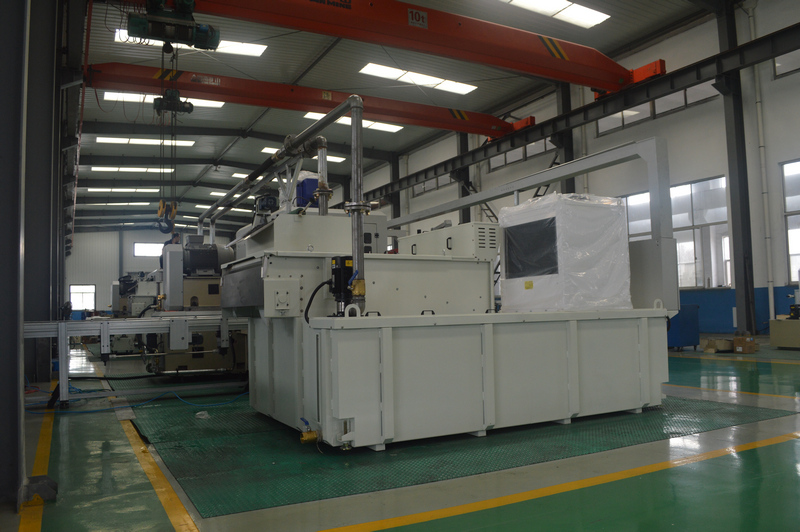
Secondly, it revolutionises efficiency. On batch production lines, time equates to cost. Double disc grinding machines typically employ continuous or rotary feeding systems, allowing workpieces to be fed into the grinding zone without interruption, resulting in an almost continuous machining process. Compared to single-face grinders requiring the cumbersome cycle of ‘grinding Face A – flipping – clamping – grinding Face B’, double disc grinders reduce production cycle times by over half, enabling genuinely efficient, high-volume manufacturing. For industries like automotive and bearings, where production cycles are measured in seconds, this efficiency advantage is decisive.
Moreover, double disc grinding machines excel at tackling machining challenges for certain ‘specialised’ components. For instance, ultra-thin or fragile parts (such as silicon wafers or ceramic discs) are highly susceptible to deformation or fracture under conventional clamping and grinding methods. Double disc grinding machines overcome this by employing precision support guides and balanced grinding forces to provide stable ‘bridge’ support for the workpiece. This ensures stability throughout the grinding process, enabling high-quality machining outcomes.