


In modern manufacturing, where efficiency and precision are paramount, double disc grinding machines are increasingly becoming the core choice for numerous production scenarios. When selecting equipment, understanding their fundamental differences from traditional single-end grinding machines is key to making the right decision. Opting for a double disc grinding machine is not merely an equipment upgrade, but a revolution in production efficiency.
From an operational perspective, a single-face grinding machine functions much like manually polishing an object – meticulously treating only one surface at a time. When a part requires dual-surface machining, the operator must complete one side before flipping, repositioning, and re-clamping the workpiece to process the other. This process not only consumes valuable production time on repetitive clamping operations but also introduces potential positioning errors during the second setup.
The double-sided grinding machine embodies a radically different philosophy of efficiency. Functioning like a precision conveyor tunnel, the workpiece passes through the feeding system in a single operation, with two grinding wheels positioned above and below rotating simultaneously to perform the grinding. This means that the machining of two parallel end faces is completed synchronously in the same instant and under the same clamping conditions. This “single-pass” principle fundamentally eliminates the intermediate flipping step, drastically shortening production cycles and achieving exponential gains in efficiency.
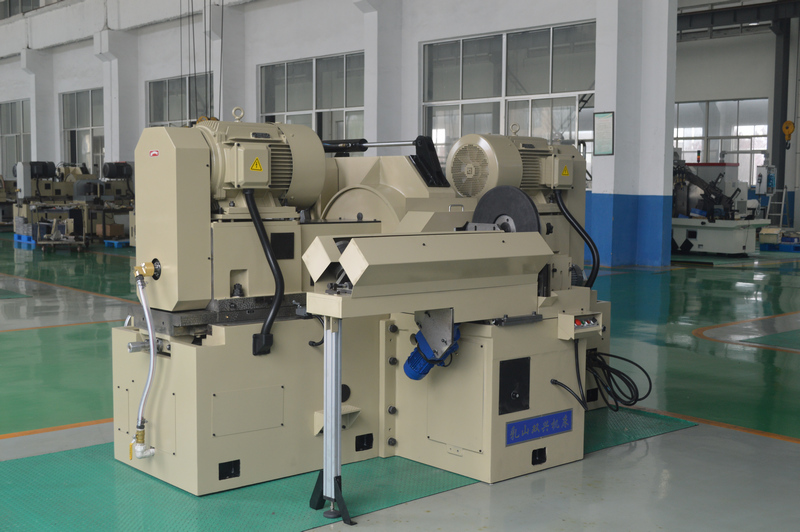
Beyond efficiency, consistency in precision is the double disc grinding machine's winning edge. On single-face machines, processing two faces during separate clamping operations makes it challenging to guarantee exceptional parallelism and absolute dimensional uniformity across batches. The double-face grinding machine, however, leverages its inherent structural advantage to ensure both reference surfaces are formed within the same coordinate system. This effortlessly achieves unparalleled parallelism and dimensional stability – a critical requirement for precision components such as bearings and piston rings.
Naturally, single-face grinding machines remain indispensable in their specific applications, such as single-surface machining, flexible production of small batches with multiple varieties, or processing workpieces with special shapes. However, when your production targets large-scale, high-volume output with an extreme pursuit of efficiency and consistency, the comprehensive value delivered by double disc grinding machines far exceeds their initial investment. They represent a more advanced and reliable manufacturing solution tailored for large-scale production.