


In industrial applications, bearing reliability directly determines the performance and lifespan of mechanical equipment. The quality of bearing ring end faces serves as a key indicator of overall bearing quality. As the core equipment for achieving this standard, double disc grinding machines play an indispensable role in bearing manufacturing through their unique processing methodology.
Unlike traditional sequential single-face grinding methods, the core advantage of double-face grinding machines lies in simultaneously machining both end faces of the raceway. This synchronous processing mode fundamentally ensures parallelism between the end faces while effectively controlling dimensional tolerances, providing a stable quality foundation for mass production.
Achieving this goal requires comprehensive coordination across the process system. For precision control, high-rigidity spindles and precision feed systems ensure grinding stability, yielding uniform surface roughness. Positioning relies on specialized fixtures that secure the rings in precise alignment, guaranteeing end-face perpendicularity to the inner and outer diameters meets design specifications.
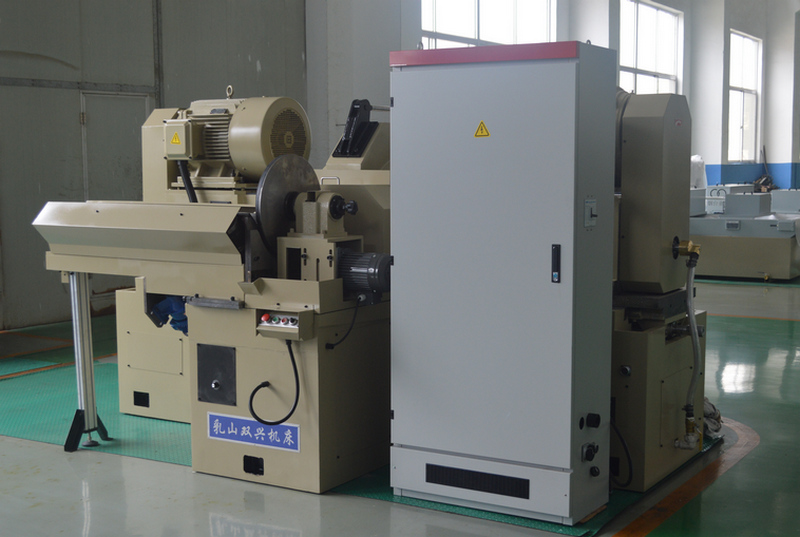
Process solutions must also adapt to different bearing types. For instance, deep groove ball bearing rings often employ through-feed methods to enable efficient, continuous automated production. Conversely, components with complex profiles, such as tapered roller bearings, require specialized fixtures to precisely secure reference surfaces and prevent deformation during grinding.
Indeed, the double disc grinding machine has become a standard process in modern bearing manufacturing due to its highly efficient machining method and stable precision output. Through precise control of dimensions, parallelism, and surface quality, it lays a solid foundation for the exceptional performance of various bearing types.