


Recent technological advancements in double disc grinding technology have closely aligned with production demands. Manufacturers adopting the new equipment have noticed significant improvements in processing efficiency, resulting in smoother production flows than before.
Previously, manufacturers faced two major challenges when processing high-hardness materials like stainless steel and special alloys: either the ground workpieces failed to meet precision standards, with dimensional errors exceeding industry norms, necessitating rework; or even if ground in a single pass, an additional correction step was required, prolonging production cycles while wasting labor and materials. The new dual-face grinding machines now specifically optimize core grinding processes — by adjusting the matching ratio of grinding wheel speed and feed rate, combined with more wear-resistant grinding wheel materials, ensuring smoother grinding of hard materials. Simultaneously, a new high-precision transmission system has been adopted, utilizing a servo motor and ball screw combination to reduce mechanical transmission clearance errors. This ultimately stabilizes workpiece dimensional errors within 0.005 millimeters. Take bearing rings commonly used in automotive bearings: previously requiring two grinding passes to meet precision requirements, the new equipment now completes the process in a single pass. This eliminates secondary clamping and processing time, boosting batch processing efficiency by approximately 30%.
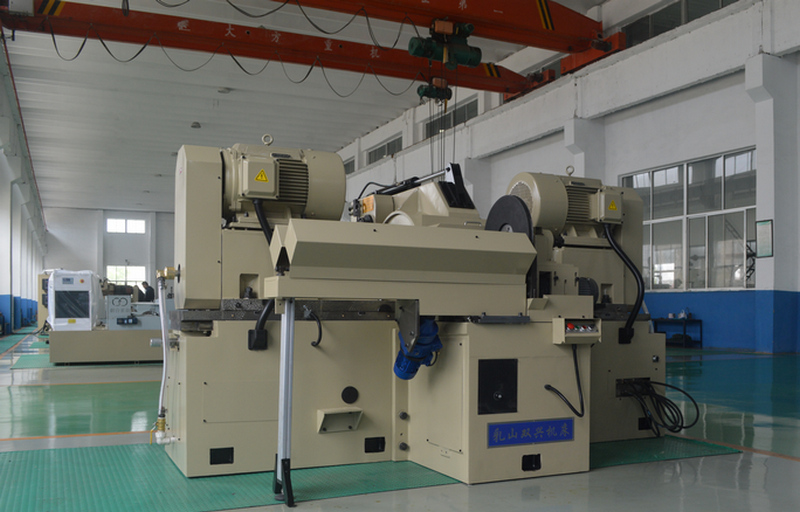
Moreover, the new equipment features significant improvements in maintenance convenience. Previously, when equipment malfunctioned, workers had to disassemble components one by one to troubleshoot, often taking 2-3 hours to identify the issue. Now, the equipment features built-in fault indicator lights and a simplified diagnostic interface that directly displays which module is problematic. Combined with clear maintenance manual guidance, workers can pinpoint faults without disassembling many parts, reducing average repair time to under 1 hour and cutting equipment downtime for repairs by half. Production lines now operate more stably and continuously, avoiding frequent shutdowns due to equipment failures. Many manufacturers report that “production schedules are easier to plan now, and we don't need to stockpile as many semi-finished products to cover downtime, making cash flow more flexible.” Overall, the production experience is significantly less troublesome than before.