


In mass production sectors like automotive components and bearing manufacturing, achieving both “high precision” and “high throughput” has long been a challenging trade-off. While traditional double disc grinding machines enabled batch processing, they required frequent manual parameter adjustments, making precision deviations all too common. The advent of the intelligent double disc grinding machine has completely overcome this challenge through three core technologies: “real-time detection, adaptive adjustment, and data traceability.” This innovation ensures both efficiency and stable precision in batch processing, establishing itself as a “smart tool” for precision manufacturing.
The precision secret of smart double disc grinding machines lies primarily in their “real-time online inspection” capability. During traditional grinding operations, workers must periodically halt the machine to take samples and measure workpiece accuracy with micrometers—a time-consuming process prone to overlooking non-conforming parts. The intelligent model, equipped with a laser thickness gauge and vision inspection system, performs precision checks synchronously during workpiece processing. For instance, when machining automotive bearing rings, the laser captures real-time end-face parallelism data with 0.0005mm accuracy. Should any deviation exceed the 0.002mm threshold, the equipment immediately triggers an alarm and halts operations.
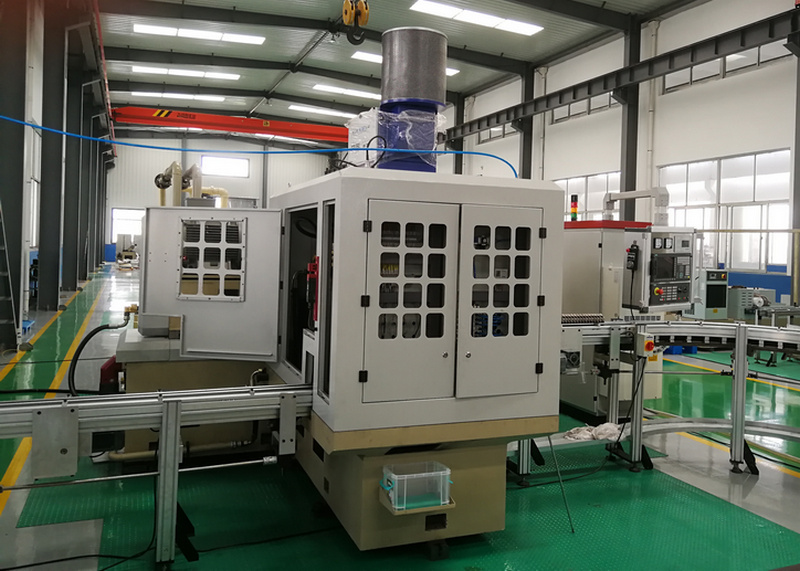
More crucially, its “adaptive adjustment” capability dynamically counters variable disruptions during batch processing. Factors like grinding wheel wear and material hardness fluctuations in batch production can easily cause subsequent workpiece precision deviations. It continuously collects over 10 parameters—including grinding wheel speed, grinding pressure, and coolant temperature—via sensors. Algorithms then automatically adjust settings: when wheel wear reduces grinding capacity, the machine compensates feed rates; if material hardness spikes in a batch, the system fine-tunes pressure to maintain consistent precision across all parts. Take automotive brake disc mass production as an example: after processing 500 pieces on a traditional grinding machine, grinding wheel wear causes thickness deviation to increase from 0.003mm to 0.008mm. In contrast, the intelligent model maintains a stable tolerance within 0.003mm after processing 2,000 pieces, fully meeting the automotive industry's “consistent precision across thousands of parts” requirement.
Furthermore, digital management functions enable traceability and optimization of precision in batch processing. The machine automatically uploads each batch's processing parameters (such as grinding wheel speed and feed rate) and precision data to the MES system, creating a comprehensive production ledger. When precision fluctuations occur in a batch, engineers can trace the data to quickly pinpoint the cause—whether it's insufficient coolant filtration precision or improper grinding wheel selection—preventing recurrence. Simultaneously, historical data analysis enables optimization of machining parameters.
In sectors demanding increasingly stringent precision—such as new energy vehicle components and precision bearings—the advantages of intelligent double disc grinding machines become even more pronounced. It can be said that these machines not only resolve precision challenges in batch processing but also drive precision manufacturing toward greater efficiency, stability, and controllability through data-driven and intelligent approaches.