


Double disc grinding machine is a kind of efficient precision machining equipment, and its most prominent feature is that it can grind both end faces of the workpiece at the same time. In practical application, the choice of grinding method is directly related to the processing efficiency, precision and scope of application of the equipment. According to the equipment structure, workpiece transmission mode, grinding contact mode and other factors, double disc grinding machine mainly has the following grinding methods:
1. Thru-face grinding
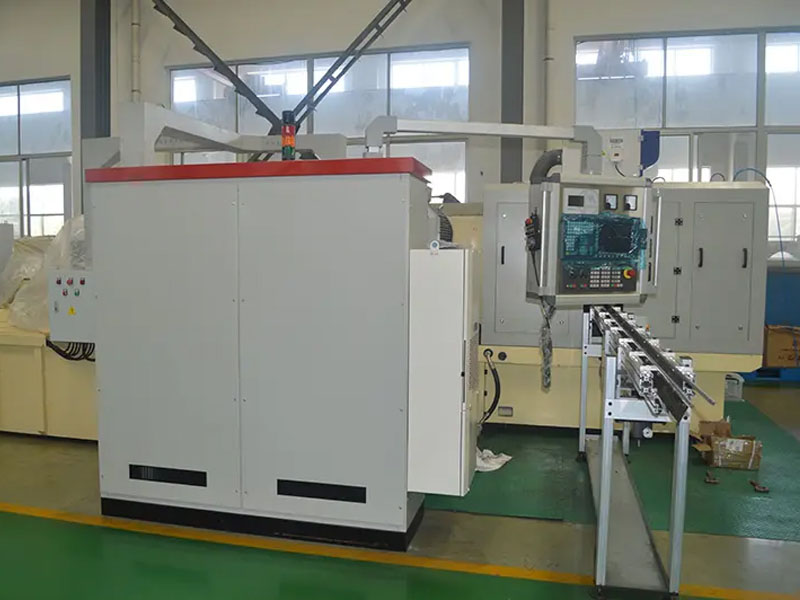
Thru-face grinding is the most common form, which is applicable to the scenario of large-volume continuous processing. In this method, the workpiece is fed into the grinding zone from one direction, passes between two oppositely rotating grinding wheels, and is automatically output from the other end.
Features:
The workpiece passes continuously without intermediate stops.
Fast machining beat, suitable for standardized and dimensionally uniform workpieces.
Suitable for thin parts such as round, square and flake.
Application Scenario:
End face grinding of bulk parts such as gaskets, washers, ceramic plates, valve plates, etc.
2. Intermittent grinding
Intermittent grinding, also known as positioning grinding, is to clamp the workpiece in a specific position, the grinding wheel is fed to grind, and the grinding wheel is withdrawn and replaced by the next workpiece after processing is completed.
Features:
One or more workpieces are machined at a time for greater precision control.
Suitable for parts with strict thickness requirements or non-uniform dimensions.
It can be used with automatic loading and unloading mechanism on one machine to complete the beat production.
Application Scenario:
non-standard parts such as bearing rings, valve gaskets, and shaped parts.
3. Reciprocating grinding
Reciprocating grinding is a method of grinding in which the grinding wheel or table is allowed to reciprocate within a certain stroke while the workpiece maintains a relative position. Compared with the penetrating type, it can grind several times per unit of time and improve accuracy.
Features:
Can be used for high precision parts that require multiple light cuts.
Better flatness and parallelism of machined surfaces.
Usually suitable for thin or easily deformed workpieces.
Application Scenario:
Precision sheet parts, IC ceramic substrates and other parts that require extremely high end face flatness.
4. Continuous rotary grinding
In this method, the workpiece is fixed on a round carrier disk and rotates with the carrier disk, and receives grinding from the upper and lower grinding disks continuously during the rotation, which is suitable for simultaneous machining of several small parts.
Features:
The workpieces are arranged densely and the processing efficiency is high.
Strong consistency, uniform distribution of grinding force.
Mostly used for round, sheet-like parts.
Application Scenario:
micromotor gaskets, powder metallurgy parts, magnetic materials and so on.
5. Single-side feeding + double-sided grinding
Some workpieces require special clamping or manual intervention, in which case a single-side loading is used, the workpiece is clamped and then double-sided grinding is completed in one pass.
Features:
Suitable for workpieces with complex shapes that require positioning.
Slightly less efficient, but more flexible.
Often used in conjunction with customized fixtures.
Application Scenario:
Specialty parts, small orders, or prototype stage use.