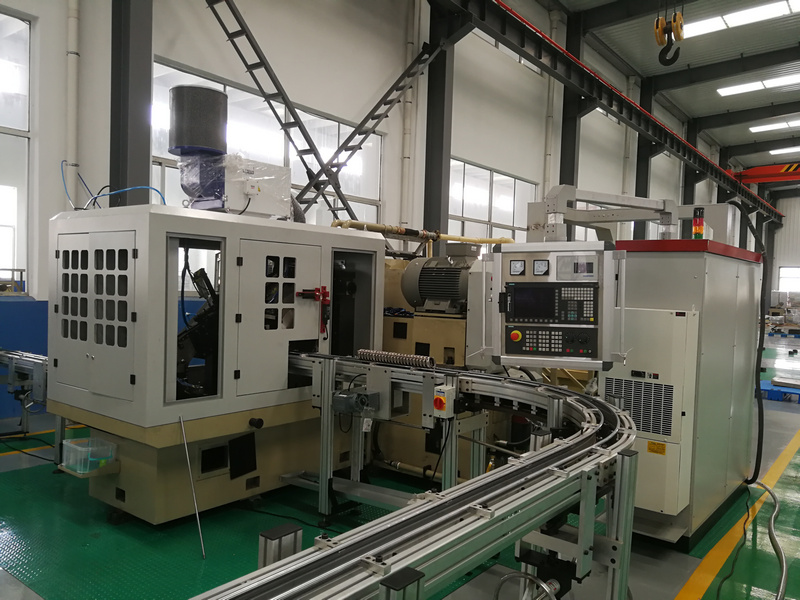


In the bearing and precision component industries, end-face quality often determines overall product performance. Whether for rolling bearings, plain bearings, or precision spacers and rings, face parallelism, thickness consistency, and surface condition directly affect friction behavior, assembly accuracy, and service life.
Double disc grinding machines are widely adopted to meet these demanding requirements. By grinding both end faces simultaneously, the machine establishes stable dimensional relationships in a single operation. This process is particularly suitable for symmetrical components such as bearing rings and is well aligned with the high consistency required in mass production.
In real bearing manufacturing environments, double disc grinding machines are commonly paired with automatic feeding systems to achieve continuous and stable cycle times. Compared with traditional single-face machining, this approach improves productivity while reducing variability caused by manual intervention. For manufacturers, stability is often more valuable than peak machine speed.
The long-term reliability of double disc grinding machines further reinforces their importance in bearing production. With proven process parameters and standardized operation, manufacturers can achieve large-scale output without compromising quality.
For these reasons, double disc grinding machines have become more than machining tools in the bearing industry—they are essential components of reliable delivery and quality assurance systems.