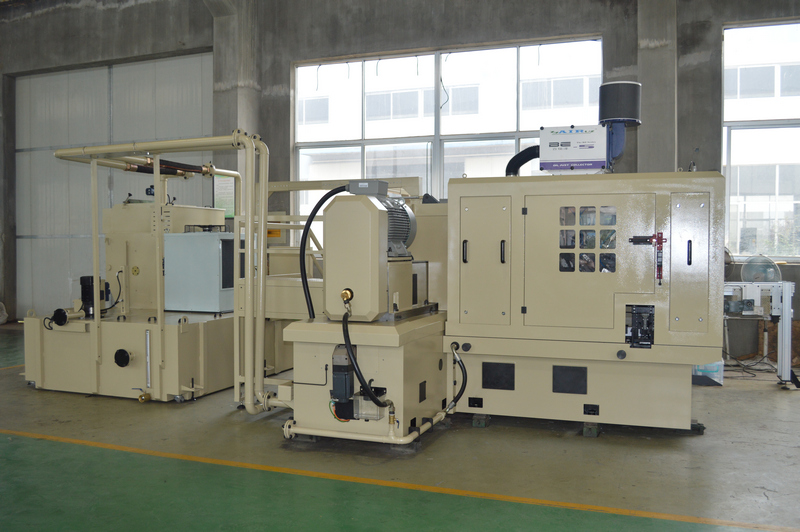


In precision component manufacturing, end-face parallelism and thickness consistency are critical indicators of machining quality. The double disc grinding machine is specifically designed to meet these high-precision requirements and is widely used in industries where dimensional stability is essential.
A double disc grinder uses two opposing grinding wheels to machine both end faces of a workpiece simultaneously. Because the grinding forces are symmetrically distributed, the workpiece experiences more balanced stress during processing, effectively reducing the risk of deformation. This structural advantage makes double disc grinding especially suitable for thin-walled or high-precision parts.
In addition, these machines are equipped with high-precision guideways, CNC-controlled feed systems, and automatic compensation technologies. Grinding parameters can be adjusted in real time according to wheel wear, ensuring long-term dimensional stability even under continuous mass production.
In practical applications, double disc grinding machines can easily achieve end-face parallelism within a few microns while maintaining stable thickness tolerances. This is particularly important for components such as bearing spacers, valve plates, and powder metallurgy parts, helping improve assembly accuracy and service life.
As the demand for advanced equipment and precision machining continues to grow, double disc grinding machines are evolving toward higher accuracy and smarter control. With the integration of CNC systems, in-line inspection, and data feedback technologies, they have become a key solution in high-precision end-face grinding.