


As a precision tool within the mechanical processing sector, the double disc grinding machine demonstrates exceptional advantages in precision control through its unique synchronous grinding design utilising dual grinding wheels. It meets stringent requirements for workpiece end-face machining across multiple industries, with its precision primarily manifested across three core dimensions: dimensional accuracy, parallelism, and flatness.
Regarding dimensional accuracy, these machines achieve micrometre-level machining control. For conventional metal workpieces, end-face dimensional tolerances are typically maintained within ±0.002mm to ±0.005mm, with select high-precision models attaining ±0.001mm—fully meeting the assembly requirements of precision components. For instance, components such as piston pins and valve tappets in the automotive sector, or magnetic rings and silicon steel sheets in electronics, demand exceptional consistency in end-face thickness. By synchronously grinding both end-faces, these machines eliminate dimensional deviations inherent in single-end grinding, ensuring uniformity across every workpiece in batch production.

Parallelism stands as one of the core strengths of double disc grinding machines. Employing a structure where upper and lower grinding wheels are arranged in parallel and operate synchronously, the workpiece experiences uniform grinding force during processing. This effectively ensures parallelism error between the two end faces does not exceed 0.002mm/m, with high-end equipment capable of controlling this within 0.001mm/m. This precision is critical for components requiring high-accuracy assembly, such as bearing rings and hydraulic valve blocks, where end-face parallelism directly impacts operational smoothness and service life. The high-precision parallelism machining of double disc grinding machines significantly enhances overall product performance.
Flatness control also demonstrates outstanding performance. By optimising grinding wheel materials, grinding parameters, and employing online detection compensation technology, the double-face grinding machine can control the flatness error of workpiece end faces within 0.001mm to 0.003mm. For precision structural components in aerospace applications and core parts within medical devices, flatness not only determines assembly accuracy but also impacts critical metrics such as sealing performance and force distribution uniformity. The high-precision flatness machining capability of double-face grinding machines provides reliable assurance for such demanding products.
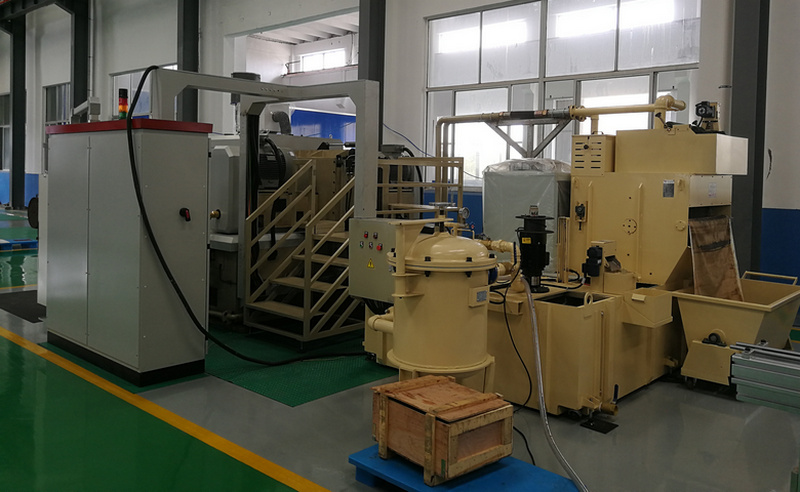
Moreover, in batch production, double disc grinding machines maintain consistent precision stability. Through integrated automated feeding, grinding, and inspection processes, they minimise human operational errors, ensuring sustained accuracy during prolonged continuous machining. Whether in large-scale production sectors like automotive, electronics, and aerospace, or niche high-end fields such as precision instruments and medical devices, double-face grinding machines can flexibly adjust process parameters according to workpiece materials (metals, ceramics, semiconductors, etc.) and machining requirements. This adaptability fulfils high-precision machining demands across diverse scenarios, establishing these machines as indispensable key equipment in modern precision manufacturing.